
DC DC Converter: Types, Applications, Benefits and How to Choose the Right One
A DC DC converter is an essential component in modern electrical and electronic systems. It converts one DC voltage level into another, helping industrial equipment, railway systems, telecom infrastructure, defence electronics and medical devices receive stable, regulated power.
Choosing the right DC DC converter involves more than matching input and output voltages. Engineers must also consider power ratings, efficiency, electrical isolation, protection features, cooling, mounting and operating conditions.
This guide explains the types of DC DC converters, their working principles, applications, benefits and the specifications to consider when selecting a suitable solution.
What Is a DC DC Converter?
A DC DC converter is a power electronic device that changes direct current (DC) from one voltage level to another. Depending on its design, it can increase voltage, reduce voltage or provide an isolated and regulated output.
For example, an industrial system may receive 48V DC but require 24V DC for its control circuits. A suitable DC DC converter can provide the required output within its specified operating limits.
DC DC converters are commonly used when:
- The input and output voltages are different.
- Electronic equipment requires a regulated DC supply.
- Multiple DC voltage levels are needed within one system.
- Electrical isolation is required by the system design.
- Redundant power sources are used to improve availability.
- Equipment must operate within a defined range of input voltage variations.
How Does a DC DC Converter Work?
A DC DC converter uses electronic switching components and energy-storage elements to control the transfer of electrical energy. Depending on its topology, it may use inductors, capacitors, transformers and semiconductor switches.
A typical switching converter operates through the following stages:
- DC input: The converter receives power from a battery, DC bus or other DC source.
- Electronic switching: Semiconductor switches control the energy transfer.
- Energy conversion: Inductive, capacitive or transformer-based components help achieve the required voltage conversion.
- Output regulation: The control circuit adjusts switching operation to maintain the specified output under supported operating conditions.
- Protection and monitoring: Depending on the model, protection circuits detect abnormal electrical or thermal conditions.
Actual operating principles vary by converter topology. Engineers should consult the manufacturer's datasheet for operating limits, dynamic performance and protection behaviour.
Types of DC DC Converters
1. Step-Down DC DC Converter (Buck Converter)
A step-down converter reduces a higher DC input voltage to a lower output voltage. For example, it can convert 48V DC to 24V DC. These converters are widely used in industrial control panels, automation systems, embedded electronics and communication equipment.
2. Step-Up DC DC Converter (Boost Converter)
A step-up converter increases the output voltage above the input voltage. For example, a suitable design may convert 24V DC to 48V DC. Common applications include battery-powered equipment and systems requiring a higher DC bus voltage.
3. Isolated DC DC Converter
An isolated DC DC converter provides galvanic isolation between the input and output through an appropriate isolation barrier, typically involving a transformer. Isolation can support electrical safety, noise management and system architecture requirements. The actual safety performance depends on the converter's certified specifications and its installation.
4. Non-Isolated DC DC Converter
A non-isolated converter does not provide galvanic isolation between input and output. Buck, boost and buck-boost circuits are common examples. These designs can offer compact size and high efficiency where isolation is not required.
5. Redundant DC DC Power Systems
Redundant power systems use multiple power sources or conversion paths to help maintain power availability. Suitable converters may include ORing functionality or support external redundancy circuits. System-level design must account for load sharing, fault isolation and failure behaviour.
| Converter type | Main function | Typical application |
|---|---|---|
| Step-down (buck) | Reduces DC voltage | Industrial controllers |
| Step-up (boost) | Increases DC voltage | Battery-powered systems |
| Isolated converter | Provides galvanic isolation | Medical and industrial electronics, where appropriately specified |
| Non-isolated converter | Converts voltage without galvanic isolation | Embedded electronics and control circuits |
| Redundant power arrangement | Supports power continuity | Mission-critical equipment |
Benefits of DC DC Converters
A properly selected DC DC converter can improve the performance and integration of an electrical system.
- Voltage regulation: Provides a suitable DC output within the specified operating range.
- Energy efficiency: Switching designs can reduce conversion losses compared with less efficient alternatives.
- Flexible integration: Supports different voltage levels across equipment and subsystems.
- Electrical isolation: Isolated models can separate input and output circuits when required.
- Compact design: Many modern converters integrate power conversion and protection in a compact package.
- System reliability: Appropriate protection, thermal design and redundancy can help improve system availability.
- Application flexibility: Available designs support industrial, railway, telecom, medical and defence-related systems.
Why Is the Input Voltage Range Important?
A DC DC converter should be selected using its complete operating input voltage range rather than its nominal voltage alone. The actual voltage may change because of battery charge levels, source variation, wiring losses and operating conditions.
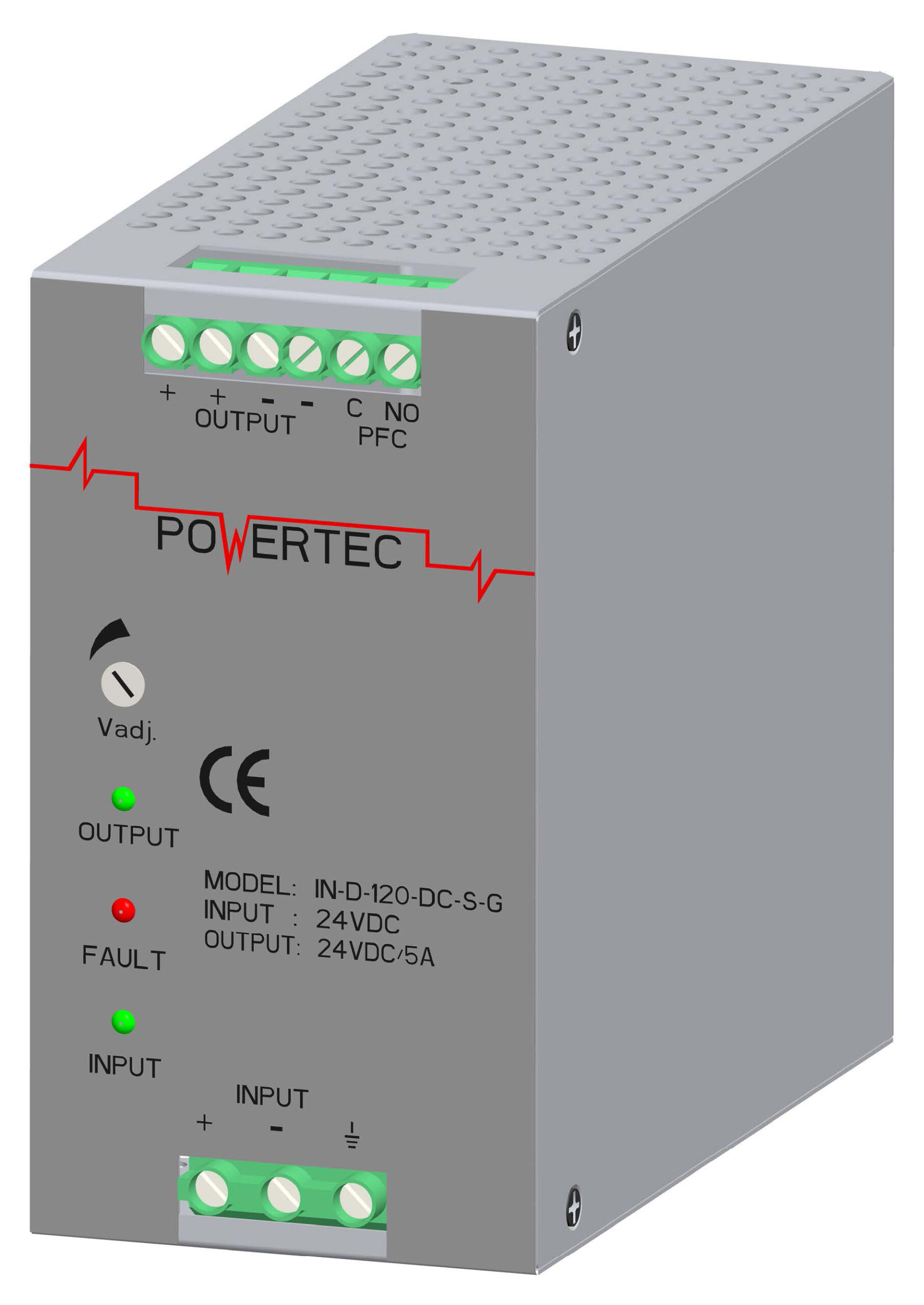
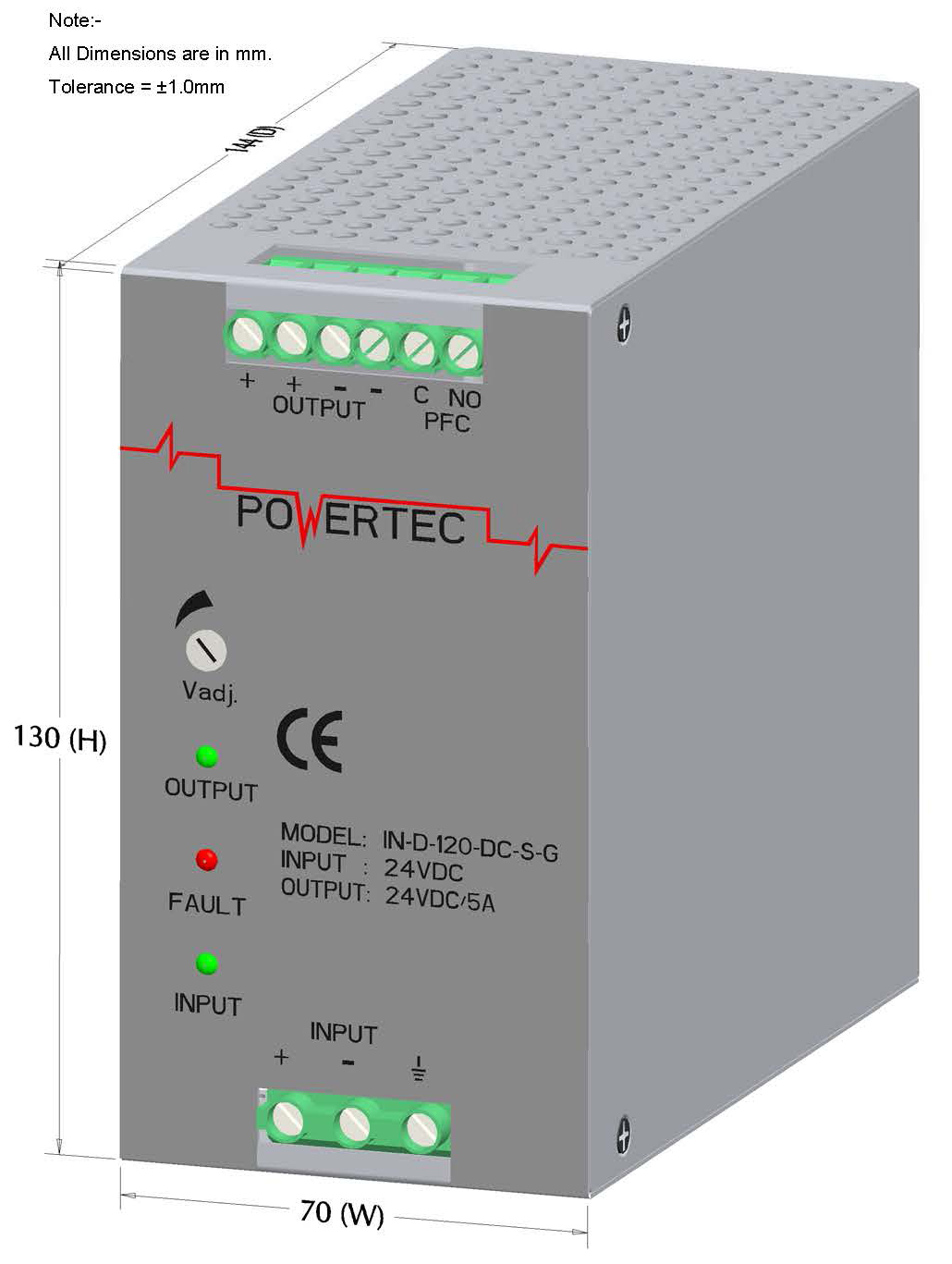
For example, Powertec's IN-D-120-DC-S-G is specified for a nominal 24V DC input, an 18–36V DC input range and a regulated 24V DC output.
- Nominal input: 24V DC
- Specified input range: 18–36V DC
- Output voltage: 24V DC
- Rated power: 120W
- Rated output current: 5A
Verify all electrical ratings and operating conditions against the current manufacturer datasheet before selecting a product.
DC DC Converter Protection Features
Industrial and mission-critical equipment may encounter electrical disturbances, abnormal loads and demanding thermal conditions. Depending on the model, useful protection features can include:
- Reverse-polarity protection
- Over-voltage protection
- Over-current protection
- Short-circuit protection
- Over-temperature protection
- Input transient protection
- Surge protection
- Output monitoring and fault indication
Powertec's industrial DC DC converter range includes models with protection features such as reverse-polarity, over-current, short-circuit and over-temperature protection. Available functions differ by product, so check the relevant datasheet.
DC DC Converters for Industrial Applications
Industrial automation systems use DC power to operate programmable logic controllers (PLCs), sensors, communication equipment, control panels and other electronic devices. A suitable industrial DC DC converter helps provide the voltage required by these loads.
Powertec offers industrial power conversion solutions with different electrical configurations and selected mounting options, including DIN-rail and back-plane mounting.
When evaluating an industrial DC DC converter, consider:
- Input voltage range and output regulation
- Continuous power and output current
- Conversion efficiency and thermal performance
- Cooling and mounting requirements
- Protection functions and fault behaviour
- Environmental conditions and EMC requirements
- Required certifications and industry standards
Explore Powertec's DC DC converter range and industrial power solutions for available product information.
DC DC Converters for Railway Applications
Railway electrical systems can experience wide input voltage variations, electrical transients, vibration and temperature changes. Railway power conversion equipment must therefore be evaluated against the requirements of the intended installation.
Powertec's railway power solutions include a triple-output DC DC converter with the following stated specifications:
| Parameter | Specified value |
|---|---|
| Nominal input | 110V DC |
| Input voltage range | 66–154V DC |
| Output configuration | +15V, -15V and +15V |
| Output current | 8A, as stated in the referenced product information; verify per output |
| Parallel operation | Listed as supported; confirm model-specific conditions |
| Standards listed | IEC 60571, IEC 61373 and IEC 62236-3-2 |
Confirm the precise output-current ratings, certification scope and applicable standards with the manufacturer before specifying a railway converter for a project.
DC DC Converters for Medical Equipment
Medical electronic systems require careful consideration of electrical safety, isolation, leakage current and system-level compliance. The correct power conversion solution depends on the medical device classification and the complete electrical design.
Powertec's medical power portfolio includes DC DC converters in the 1W to 60W range with 2xMOPP transformer technology, according to its product information.
When selecting a converter for medical equipment, evaluate:
- Required isolation and means of patient protection
- Leakage current and dielectric withstand specifications
- Output voltage, current and power
- Thermal performance and operating conditions
- Applicable medical electrical safety standards
- System-level compliance and manufacturer documentation
Do not assume that a converter's individual specifications automatically establish compliance for the complete medical device.
DC DC Converter with ORing Function
ORing is a technique used in redundant power systems to help prevent unwanted reverse current between power sources. It can allow multiple supply paths to support a common load while helping isolate a failed source, depending on the circuit design.
ORing may be implemented using diodes or suitable semiconductor-based circuits. Powertec offers dedicated ORing diode products and DC DC converter models with integrated ORing functionality.
Its IN-D-120-DC-S-G model is listed with an inbuilt ORing diode for redundancy and power sharing. Confirm the permitted configuration, current limits and load-sharing behaviour in the product documentation.
When designing a redundant power architecture, evaluate source compatibility, reverse-current behaviour, fault isolation, thermal losses and the response to a failed power supply.
How to Choose the Right DC DC Converter
1. Check the Input Voltage
Identify the nominal voltage and the minimum and maximum input voltage under all expected operating conditions. Include source variation and transient requirements.
2. Match the Output Voltage
Choose an output voltage compatible with the connected equipment and its permitted tolerance. Also consider output ripple and transient response where relevant.
3. Calculate Output Current
Determine the maximum continuous load current, startup demand and any temporary peak current. Apply suitable engineering margin based on the manufacturer's derating guidance.
4. Calculate the Required Power
Use the formula:
For example: 24V × 5A = 120W.
A 24V, 5A load therefore requires 120W of output power under these conditions. The converter must also be suitable for the actual thermal and operating environment.
5. Compare Efficiency
Higher conversion efficiency can reduce power losses and heat generation. Compare efficiency at the expected load rather than relying only on the maximum efficiency figure.
6. Evaluate Cooling
Review natural convection, forced-air cooling, heat-sink requirements and installation clearances. Check any power derating required at elevated ambient temperatures.
7. Verify Protection Features
Assess reverse polarity, over-current, short-circuit, over-temperature and input transient protection according to the risks associated with your application.
8. Select the Mounting Type
Choose DIN-rail, back-plane, chassis or other mounting options that suit the enclosure, wiring layout and maintenance requirements.
9. Check Environmental Requirements
Evaluate operating temperature, storage temperature, humidity, vibration, altitude, electromagnetic compatibility and relevant industry standards.
10. Consider Redundancy
Where uninterrupted operation is important, assess ORing, parallel operation, load sharing, monitoring and system-level redundancy. Do not assume every converter supports parallel operation.
Why Choose Powertec Supplies for DC DC Conversion?
Powertec Supplies India Pvt. Ltd. provides power conversion solutions for industrial, railway, defence, medical and other specialised applications.
Its product portfolio includes:
- DC DC converters
- AC DC converters and rectifiers
- ORing diode solutions
- Automatic transfer switches
- Specialised industrial power systems
Powertec also works with power conversion brands including Cosel, SynQor and P-DUKE. Verify current authorisation and product availability directly with the company.
For product selection, compare the required electrical ratings, protection features, mounting options and operating conditions with the relevant manufacturer documentation.
Related Power Conversion Resources
- Explore Powertec DC DC converters
- View the IN-D-120-DC-S-G product details
- Explore railway power solutions
- Texas Instruments: DC/DC converter overview
Frequently Asked Questions About DC DC Converters
1. What is a DC DC converter used for?
A DC DC converter changes one DC voltage level to another. It is used in industrial automation, railway equipment, telecom systems, medical electronics, battery-powered devices and other electronic applications.
2. What are the main types of DC DC converters?
The main types include step-down (buck), step-up (boost), buck-boost, isolated and non-isolated converters. Redundant power arrangements may also use converters with ORing or parallel-operation capabilities.
3. How do I calculate the power rating of a DC DC converter?
Multiply output voltage by output current. For example, a 24V output at 5A requires 120W of output power. Check startup demand, ambient temperature and manufacturer derating requirements before choosing a model.
4. What is an isolated DC DC converter?
An isolated DC DC converter provides galvanic isolation between its input and output circuits. Its suitability depends on the isolation rating, safety requirements and overall system design.
5. Why is input voltage range important?
The input voltage range defines the limits within which a converter is specified to operate. The source voltage must remain within the permitted range under the expected operating conditions.
6. What is ORing in a DC power system?
ORing helps prevent unwanted reverse current between power sources in a redundant power arrangement. Its effectiveness depends on the circuit, component ratings and overall system design.
7. How do I choose a DC DC converter for railway applications?
Check the input voltage range, output ratings, isolation, temperature performance, vibration requirements, transient immunity, EMC requirements and applicable railway standards.
8. Can a DC DC converter be used in medical equipment?
Yes, if the converter meets the specific electrical safety, isolation, leakage-current and performance requirements of the intended medical device. The complete device must be evaluated for applicable compliance.
Final Thoughts
Selecting the right DC DC converter requires an engineering assessment of voltage, current, power, efficiency, protection, cooling, environmental conditions and system architecture.
From industrial automation and railway systems to medical electronics and mission-critical equipment, the correct converter must match the actual electrical and environmental requirements of the application.
Looking for the Right DC DC Converter?
Discuss your input voltage, output voltage, power rating, mounting requirements and operating conditions with Powertec Supplies to identify a suitable power conversion solution.
Contact Powertec Supplies